

EVEREST in Motion is a new interview series where we go behind the scenes of the EVEREST project to meet the experts shaping the future of nuclear modeling and simulation. To reach the "summit" of multiphysics excellence, our partners are working across distinct Work Packages to enhance the accuracy of safety assessments for long-term reactor operation.
In our first edition, we sit down with Nuria García-Herranz (Universidad Politécnica de Madrid), the lead of Work Package 1 to discuss the critical task of characterizing the neutron source term. From modeling European pressurized water reactors to bridging the gap between research and industry, discover how WP1 is setting the foundation for high-resolution reactor pressure vessel (RPV) analysis.
Which part of the EVEREST work are you leading?
I am leading Work Package 1 (WP1) of the EVEREST project. This work package addresses one of the key challenges in accurately evaluating neutron fluence in the reactor pressure vessel (RPV) of pressurized water reactors (PWRs): the characterization of the neutron source term. Traditionally, this aspect has received less attention than other contributors to fluence uncertainty.
WP1 focuses on assessing the added value of advanced multi‑physics modelling to obtain a more realistic representation of the neutron source and to quantify its impact on fast neutron fluence in the RPV and reactor internals. This is particularly relevant for long‑term operation, where reliable assessments of RPV ageing play a central role in safety analyses.
Could you share some early results from your work package and the strategic roadmap that will guide your next steps?
WP1 is currently in an intense development phase. Our main activity is the modelling and simulation of three European pressurized water reactors (Beznau in Switzerland, Grohnde in Germany, and Paks in Hungary), which provided the experimental measurements needed to validate in‑core calculations using both conventional and advanced multi‑physics approaches. In the conventional approach, the neutron source is determined from assembly‑level calculations with reconstructed pin powers, while the advanced approach explicitly models the neutron source at full pin‑wise resolution.
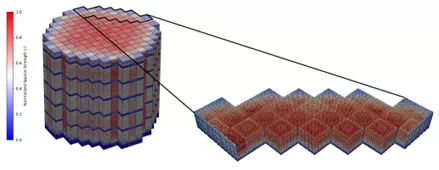
Figure 1: The figure illustrates how the neutron source can be described at both the fuel assembly (on the left) and fuel pin levels (on the right). Source: D. Timpano et al., Uncertainty quantification for a vessel fluence calculation: a PWR case study, Progres Progress in Nuclear Energy, 193 (2026), https://doi.org/10.1016/j.pnucene.2025.106234.
Nine institutions, including academia, research centres, regulatory bodies, and industry, are participating, each applying its own multi‑physics computational methodology (coupling neutronics, thermal‑hydraulics, and thermo‑mechanics) and performing full core‑follow simulations.
The first step of the WP1 roadmap is to establish robust results with conventional methods. These models are being carefully applied to minimise biases relative to experimental measurements, ensuring that the benefits of advanced high‑resolution multi‑physics tools can later be assessed in a reliable and transparent manner. Preliminary results confirm the high maturity of current methods, but they also indicate that the source term accuracy may be limited by the treatment of the reflector. Further attention to this aspect is crucial, as strong spatial power variations in the peripheral assemblies —highly sensitive to reflector modelling— dominate the neutron field that drives RPV fluence.
What’s next for your Work Package?
The next steps will focus on implementing advanced multi‑physics and high‑resolution in-core modelling, ensuring, where feasible, consistency with the corresponding conventional approaches. The resulting source terms will then be used as input for ex‑core transport calculations of neutron fluence. This will allow us to systematically assess differences between modelling strategies and to quantify the sensitivity of fast neutron fluence in the RPV and internals.
Additionally, because in‑core measurements in commercial NPPs do not reach the level of detail available in the highly instrumented research reactors studied in WP2 and WP3, WP1 will evaluate the representativity of research reactor experiments for commercial PWRs. This step is essential to understand how experimental findings can be meaningfully extrapolated to industrial conditions.