

EVEREST in Motion a our series exploring the technical milestones of the EVEREST project. To reach the pinnacle of nuclear safety and modeling, we must ensure our tools are as versatile as they are accurate.
In this interview, we sit down with Dr. Klemen Ambrožič, Researcher at the Jožef Stefan Institute and the leader of Work Package 3 to discuss the development of advanced reactor instrumentation designed to generate high-resolution multi-physics data for validating complex modeling codes. Discover how this Work Package is pushing the boundaries of reactor diagnostics to bridge the gap between numerical simulation and physical reality.
Which part of the EVEREST work you are leading?
As the lead for Work Package 3, I oversee the development and application of novel instrumentation in research nuclear reactors. Our goal is to conduct high-resolution multi-physics experiments that provide essential validation data for advanced modelling codes.
Could you share some early results from your work package and the strategic roadmap that will guide your next steps?
Neutron Detection & Profiling Axial neutron profiling was recently completed at three research reactors: JSI TRIGA, the BME Training Reactor, and the Budapest Research Reactor. Additionally, testing of scintillator and optical fiber-based neutron detectors has successfully transitioned from the zero-power EPFL CROCUS facility to the higher-flux environment of the BME reactor. Further testing to investigate Campbell mode readout capabilities is scheduled at the JSI TRIGA reactor for Q2 2026.
Thermal-Hydraulics & In-Core Measurements A Particle Image Velocimetry (PIV) mock-up of an electrically heated BME fuel element is actively being used to validate fluid flow distributions. Building on past spatial coolant temperature measurements, upgraded systems for the reactor pool and core are currently awaiting regulatory approval. Concurrently, a fresh BME fuel assembly is being instrumented with an array of thermocouples and provisions for flux mapping via miniature fission chambers.
Non-Contact Measurement Innovations We are developing non-contact systems for fluid flow and temperature measurement using optical Schlieren and ultrasonic time-of-flight techniques. These methods have advanced past numerical simulation and are now undergoing initial qualification testing. Furthermore, non-contact fuel cladding temperature measurement techniques based on ultrasound and inductive properties remain under active investigation.
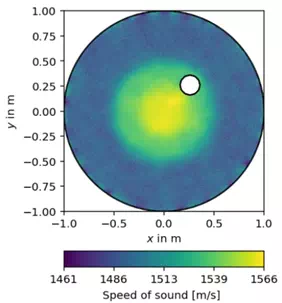
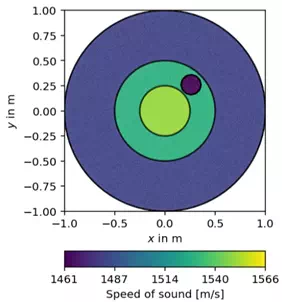
Figure 1 : (Left) reconstructed speed of sound vs real speed of sound (right) in the JSI TRIGA reactor tank using the Time of flight method and 256 ultrasonic transducers arranged the the tank’s perimeter.
What’s next for your Work Package?
The upcoming steps for this Work Package involve concluding the regulatory processes for our developed measurement techniques and accelerating our research into non-contact methods. By successfully qualifying and incorporating these technologies into benchmark-quality experiments, we will supply vital multi-physics validation data to both the EVEREST project and a larger audience of interested stakeholders.